




5 hours ago6 min read


5 hours ago6 min read


5 hours ago6 min read


10 hours ago6 min read


11 hours ago6 min read
There is no California fence height. There is a Temecula fence height, a Murrieta fence height, and a different answer again if your address turns out to be in unincorporated county.
People move here from Los Angeles or San Diego, apply what they knew, and build something that has to come down. Here is what actually applies in southwest Riverside County.
The front setback is the strict one.
Solid fences, hedges and walls in the front setback are limited to three feet.
Note that hedges are included, the same as in most California cities. Planting instead of building does not change the limit.
Everywhere else on the property, fences and walls may reach six feet.
This is the part almost nobody knows, and it is the most useful thing in this article.
A combination of solid and open fencing may reach six feet in the required front yard, corner or side yard, provided at least ninety percent of the top three feet of its vertical surface is open and non-view-obscuring.
In practice that is a three-foot solid base with an open element above it: tubular steel, wrought iron, wide-spaced pickets. Not lattice, which is not ninety percent open. Not slats with a small gap.
So the honest answer to can I have a six foot fence in my front yard in Temecula is: yes, if you can see through the top half of it. That is the trade, and it is a reasonable one, because the rule exists for visibility rather than aesthetics.
One material is simply out: chain link is prohibited in front yards.
Fence height in Temecula is measured at the lowest point of finished grade.
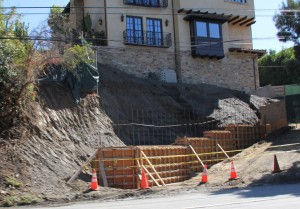
On a flat lot that is academic. On a sloping lot it is the whole conversation, because a fence that is six feet on the uphill side can be well over six feet measured from the downhill side. That is the side the measurement is taken from.
This is the single most common way a fence on a slope here ends up non-compliant after it is built.
Where fencing is installed on top of an existing wall, the combined structure still cannot exceed six feet.
This catches people constantly, because the wall is usually already there and reads as part of the ground rather than part of the fence. It is not. If you have a three-foot block wall, you have three feet of fence available above it, not six.
And if that wall is holding soil back, it is a retaining wall with its own structural and permit requirements entirely separate from the height rule: retaining walls: important to know.
At a street intersection you have to keep the sight lines clear, and the rule is specific.
Within the visibility area, nothing may exceed thirty-six inches measured from the top of the curb. That area extends fifteen feet from the curb radius on local streets and alleys, and twenty-five feet on collectors and arterials.
Corner lots are where the biggest fences get planned and the smallest ones get approved. If your lot wraps a corner, measure this before you design anything.
Murrieta exempts fences not over seven feet from needing a building permit.
That sentence gets misread constantly, so it is worth being precise about what it means and what it does not.
It means you do not pull a building permit for the structure itself. It does not mean you may build a seven-foot fence wherever you like. The zoning standards for your district, the setback rules, the corner visibility rules and any HOA covenant all still apply, and the exemption explicitly does not authorize violating any other code or ordinance.
A permit exemption is about the structure. Zoning is about where and how tall. They are two different questions, and only one of them is waived.
A large share of addresses with a Temecula or Murrieta mailing address are not inside those city limits. They are in unincorporated Riverside County, which means county standards and county permits, not the city's.
Check which jurisdiction you are actually in before you check anything else. The mailing address does not tell you.
A pool barrier.
If the fence is doing double duty as a pool barrier, the state safety requirements take over: a minimum of sixty inches, a maximum two-inch gap at the bottom, no four-inch openings, nothing climbable on the outside face, and gates that open away from the pool and self-latch high. Those numbers are stricter than the zoning limits, and a remodel permit on an existing pool can trigger them: pool decks and pool barriers in California.
A fire hazard severity zone.
Where the parcel is in a fire zone, material choice around the structure becomes a code question rather than a preference, and a combustible fence attached to the house is part of that conversation. The same rules that govern a patio cover are the ones to read: patio covers and decks in Temecula and Murrieta.
For anyone who owns property in both markets, the differences are small in wording and large in effect:
Los Angeles allows three feet six inches in the required front yard. Temecula allows three feet solid
Los Angeles allows six feet in side and rear yards and can go to eight through a discretionary Planning approval. Temecula's six feet is the limit without a variance
Temecula has the ninety percent open rule for reaching six feet in front. Los Angeles does not work that way
Murrieta's seven-foot building permit exemption has no equivalent in the Los Angeles process
The Los Angeles rules, including the hedge clause and the pool requirement specific to that city, are in fence height rules in Los Angeles.
Across the master-planned communities in Temecula and Murrieta, the association typically specifies material, color, style and sometimes which side of the property line the good face has to point toward.
The association can be stricter than the city and frequently is. It cannot be more permissive than the city. Design to whichever is tighter, and submit both at once.
Linear feet, and how much of it is in a front or corner setback
Whether the ground slopes, which changes both the height measurement and the posts
Material, and whether an HOA has already chosen it
Whether anything has to be retained, which turns a fence job into a structural one
Whether the fence doubles as a pool barrier
Whether the parcel is in a fire hazard zone
Which jurisdiction issues the permit, and whether one is needed at all
My neighbor has a six-foot solid fence in their front yard. How?
Three possibilities: it predates the current standard, it went through a variance, or nobody has complained. The third is the most common, and it becomes a problem when the property sells.
Does a hedge really count?
Yes. Hedges are named alongside fences and walls in the front setback limit.
Can I put lattice on top of my three-foot wall to get to six?
In Temecula's front setback, only if the top three feet is at least ninety percent open. Standard lattice is not, so usually no. Tubular steel or wide-spaced pickets are the materials that pass.
What does it cost?
Linear feet, material, grade, whether anything is retained, and which approvals apply all move it. Rather than publish a figure that would be wrong for your lot, we will look at it with you.
Tell us the city, whether the address is inside city limits or unincorporated, roughly how long the run is, whether it is in a front or corner yard, and whether the ground slopes. In fifteen minutes we can usually tell you what height you are allowed, whether the ninety percent rule gets you what you want, and whether a permit is in play.
Call (323) 651-0635 to book the free 15-minute consultation. If your project needs a site visit and a paid assessment, we will say so on the call rather than after it.
The Ultimate Pro, Inc. CA License 831700, Class B General Building. Serving Riverside, Los Angeles, Orange and San Bernardino counties since 1996.


Comments