




1 hour ago6 min read


2 hours ago6 min read


2 hours ago6 min read


7 hours ago6 min read


8 hours ago6 min read
This is the most common backyard question in Los Angeles, and the short answer is three numbers. The long answer is why those numbers are not the whole story on most lots.
The rule lives in Section 12.22 C.20 (f) of the Zoning Code. In most residential areas:
In the required front yard, a fence or wall may be up to 3 feet 6 inches
In the required side and rear yards, up to 6 feet
Depending on lot size and location, the side and rear limit may be increased to 8 feet
That is the framework. Almost every dispute we get called into comes from one of the exceptions below, not from the numbers themselves.
This is the part almost nobody knows, and it is written into the code itself.
For the purposes of the height rule, the terms fence and wall include latticework, ornamental fences, screen walls, hedges, and thick growths of shrubs or trees.
So the ficus hedge along the front of the property is measured under the same 3 foot 6 inch limit as a wooden fence would be. Planting instead of building does not get around the rule, and a neighbor complaint about a hedge is enforced the same way as one about a fence.
This is the second big source of confusion. The height limits apply in the required yard, which is the setback area defined by your zone, not to the whole property.
On a typical lot the required front yard is a strip along the street, and the required side yards are strips along each side. Behind and between those strips the rule is different. That is why two fences on the same street can be legal at different heights: one is inside a required yard and the other is not.
Before measuring anything, find out where your required yards actually are. The zone, the lot dimensions and any specific plan all feed into it.
The increase from 6 to 8 feet in side and rear yards is not something you decide. City Planning runs a dedicated approval for fences and walls up to 8 feet in height, and it is a discretionary review, which means a case, a finding and a timeline rather than a counter transaction.
It can be the right answer, particularly on a corner lot or against a commercial neighbor. It is not the right answer if what you need is a fence next month.
Three overlays regularly override the general rule:
Hillside areas and the Special Grading Area, where fence height is measured differently and is typically more restrictive
A Historic Preservation Overlay Zone, where what the fence is made of and what it looks like from the street both matter, not just how tall it is
Specific plans and community design overlays, which set their own standards street by street
If your property is in any of these, check the overlay before you check the general rule. The overlay wins.
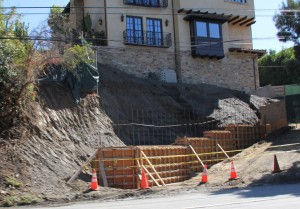
On a sloped lot the fence usually sits on top of something, and that something is often a retaining wall.
The mistake is to treat them as two separate structures, measure only the fence, and build a combination that is well over the limit. In a required yard the city generally looks at the whole assembly, not just the part made of wood.
A retaining wall is also a structure with its own permit and engineering requirements, separate from zoning. We covered that separately in retaining walls: important to know. On a hillside lot, settle the retaining wall question first and design the fence on top of it, not the other way around.
Pool fencing is a separate requirement, in Section 91.6109 of the Municipal Code, and it catches a surprising number of owners at the worst moment.
For an existing pool, fish pond or other body of water holding 18 inches or more of water, the enclosure, gates included, must be at least 4 feet 6 inches above the ground, and the gate latch must sit at least 4 feet 6 inches above the ground.
For a new pool, the more restrictive building code requirements apply: an enclosure of at least 5 feet, with gates that are both self-closing and self-latching.
Note the 18 inch threshold. It captures a lot of things people do not think of as pools, including koi ponds and some water features.
This is also the rule that surfaces during a sale or at an insurance renewal, alongside the other items that only get looked at when money is moving. If you are dealing with a pool that is losing water at the same time, that is a different problem with a different answer: pool leaks.
California has a specific rule for this, and Los Angeles has its own section on it. A fence or fence-like structure unnecessarily exceeding ten feet in height, erected or maintained maliciously to annoy the owner or occupant of adjoining property, is a private nuisance.
Neighbor disputes over fences escalate faster than almost any other property issue in this city. If a project is heading in that direction, a straightforward, compliant fence and a conversation cost less than the alternative.
Whether the fence itself needs a building permit depends on its height and how it is built. A light wood fence at the by-right height usually does not. Masonry, anything structural, and anything doing retaining work generally does, and on a slope the retaining portion almost always does.
In California any project over $500 in combined labor and materials requires a licensed contractor, which a real fence clears on day one. The reason it is worth having a general building contractor on a fence at all is that most fence problems in Los Angeles are not fence problems: they are grade, drainage and retaining problems wearing a fence.
My neighbor has a nine foot hedge. Can anything be done?
If it is in a required yard, it is subject to the same limit as a fence. That makes it a code enforcement matter rather than a purely private one.
Can I build right on the property line?
A fence on the line is common, and it is also the single most common cause of neighbor disputes. Confirm where the line actually is before you dig. A survey is cheap compared with moving a finished fence.
Does a gate count toward the height?
Yes, and for pool enclosures the code says so explicitly.
What does it cost?
Length, material, grade, whether anything has to be retained, and whether a permit or a Planning approval is involved all move it substantially. Rather than publish a number that would be wrong for your lot, we will look at it with you.
Tell us the address, roughly how long the fence is, whether the ground slopes, and whether there is a pool behind it. That is usually enough for us to tell you what height you are allowed, whether a permit is in play, and whether a retaining wall is hiding inside the job.
Call (323) 651-0635 to book the free 15-minute consultation. If it needs a site visit, we will tell you that on the call rather than after it.
The Ultimate Pro, Inc. California License number 831700, Class B General Building. Building in Southern California since 1996.


Comments